
7-minute lesson · Strategy education · CALLS · Simulation
Understand ORB three-close sustained-volume hold
Learn to check three completed closes and their volume baseline, reject a failed hold, and interpret a simulated result.
01 · Recognize the setup
What must happen before a signal?
The idea behind the alert
This setup looks for a stock or ETF to remain above its opening-range high for three completed one-minute candles. The three candles must also have enough average volume. Price confirms the hold; volume confirms participation. The reviewed configuration sends qualifying alerts and models trades in simulation. Automatic buying is off.
Build the first 15-minute range
ORB means opening range breakout. Fizz records the high and low from the first 15 regular-session minutes: 9:30–9:45 a.m. Eastern, or 8:30–8:45 a.m. Central. The range must finish before the hold begins. For QQQ on September 30, 2026, the high was $742.7493 and the low was $739.7600.
Count three completed closes
Each of the first three consecutive one-minute closes in the above-range episode must finish strictly above the opening-range high. A wick above the line is insufficient. The candles need not all be green, and their lows need not all stay above the line. A close at or below the high resets the count. The signal occurs only after the third candle completes and the volume test passes.
Compare average volume with the baseline
Divide the average underlying stock or ETF volume of the three hold candles by the average volume of the preceding baseline candles. The result must be at least 2.0. The baseline uses up to 20 preceding contiguous one-minute bars and requires at least 15. It excludes the three hold bars. This rule compares averages; it does not require every hold bar to reach twice the baseline.
What happens when volume fails
The system checks volume when the first three above-range closes complete. If that test fails, more candles in the same above-range episode do not rescue the setup. The system waits for a reset and a new episode. Missing baseline bars or invalid volume cannot count as confirmation. This avoids treating an incomplete volume comparison as a valid signal.
02 · Follow the example
Read the evidence in order
September 30, 2026 QQQ event · Simulated fills, not broker executions. Automatic buying was off in the reviewed configuration.
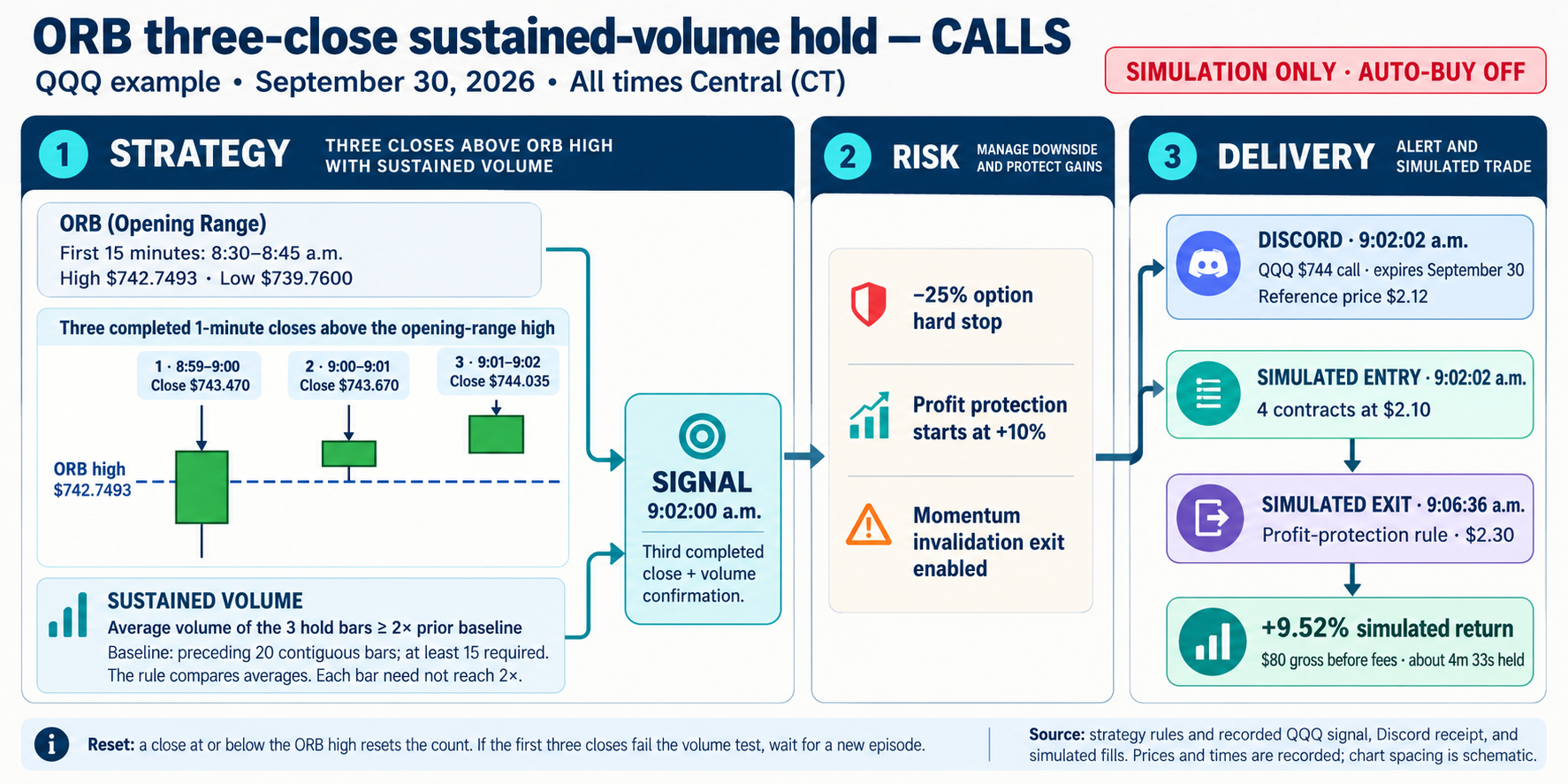
Three closes, one completed setup
QQQ opening-range high: $742.7493. Each interval below is one completed minute, in Central Time.
Close 1 · 8:59–9:00 a.m.
$743.470
Above the range high
Close 2 · 9:00–9:01 a.m.
$743.670
Above the range high
Close 3 · 9:01–9:02 a.m.
$744.035
Above the range high
Volume gate: average of the three hold bars ÷ average of the preceding baseline ≥ 2.0. Use up to 20 contiguous baseline bars, with at least 15 required.
Follow the signal and simulation
9:02:00 a.m. CT
Signal
The third candle completes. The saved assessment confirms the price and volume conditions.
9:02:02.658 a.m. CT
Simulated entry
Four QQQ September 30 $744 calls at $2.10. No broker fill is implied.
9:02:02.808 a.m. CT
Discord receipt
The alert records a $2.12 reference price for the same contract.
9:06:36.140 a.m. CT
Simulated exit
The profit-protection rule closes the simulation at $2.30, about 4 minutes and 33 seconds after entry.
+9.52% simulated return
($2.30 − $2.10) ÷ $2.10 × 100 = 9.52%.
$0.20 × 100 shares × 4 contracts = $80 gross before fees. This uses the simulated entry, not the $2.12 alert reference. It is not a realized broker profit.
Where do these numbers come from?
Fizz checked the saved QQQ signal, completed candles, volume-gate assessment, Discord receipt, simulated fills, and risk rules captured on September 30. The reviewed strategy configuration disables automatic buying. The source describes one event; later settings and results can differ.
Exact example readings and price calculations
QQQ: the three confirming candles
On September 30, the 8:59–9:00 a.m. Central candle closed at $743.470. The next closed at $743.670, and the third closed at $744.035. All three exceeded $742.7493. The saved assessment confirmed the volume gate and recorded the signal at 9:02:00 a.m. The diagram shows the required 2× threshold, not an exact observed ratio from the saved alert.
Read the alert and simulation separately
The Discord receipt is 9:02:02.808 a.m. Central. Its contract is the QQQ September 30 $744 call, with a $2.12 reference price. The simulation entered four contracts at $2.10 at 9:02:02.658 a.m. It exited at $2.30 at 9:06:36.140 a.m. These are simulated fills, not broker executions. The notification reference and simulation entry are different price bases.
Calculate the result from the correct entry
The simulated return is ($2.30 − $2.10) ÷ $2.10 × 100 = 9.52%. Four standard 100-share contracts give $80 gross before fees. Comparing the same $2.30 exit with the $2.12 alert reference gives 8.49%, a different measurement. Neither calculation proves a subscriber’s fill or personal profit. The simulation held for about four minutes and 33 seconds.
03 · Locate the risk rules
Risk rules for this example
Configuration captured for the September 30, 2026 event. These historical rules do not verify current live settings.
The risk plan captured for this event
The captured rules include a −25% option hard stop, profit protection starting at +10%, and further 10-point ratchet steps. They also enable a momentum-invalidation exit and a 20-minute exit when losing. The QQQ simulation closed under the profit-protection rule. A +10% protection threshold does not guarantee a +10% fill-based return. The saved rules do not impose a fixed 15-minute exit.
Supporting reference
How this differs from Morning OI Momentum
Morning OI Momentum uses a calls-only same-day option shortlist with an upward opening-range state. This strategy instead requires three closes and sustained underlying volume; it does not require that OI shortlist. The QQQ example is a simulation. The AMZN lesson separately labels its user-reported sale. Keep the strategy, price basis, and result type together when comparing the examples.
Use the diagram to review an alert
Check the opening-range high, the three completed candles, and the volume baseline first. Then confirm the exact option contract, alert time, reference price, and risk plan. A signal can exist without a delivered notification or a filled trade. This single winning simulation explains the process; it does not establish a win rate or expected return.
Lesson details
Owner: Fizz product team · Article reviewed: September 30, 2026