
7-minute lesson · Strategy education · SPY / QQQ · CALLS · Simulation
GEX Triple Flip: calls below VWAP and ORB low
Study a fresh turn to positive gamma, delta, and vega while SPY or QQQ stays below both VWAP and the 15-minute opening-range low. Follow the trigger logic and distinguish a new flip from readings that remain positive.
Strategy logic: every requirement must pass
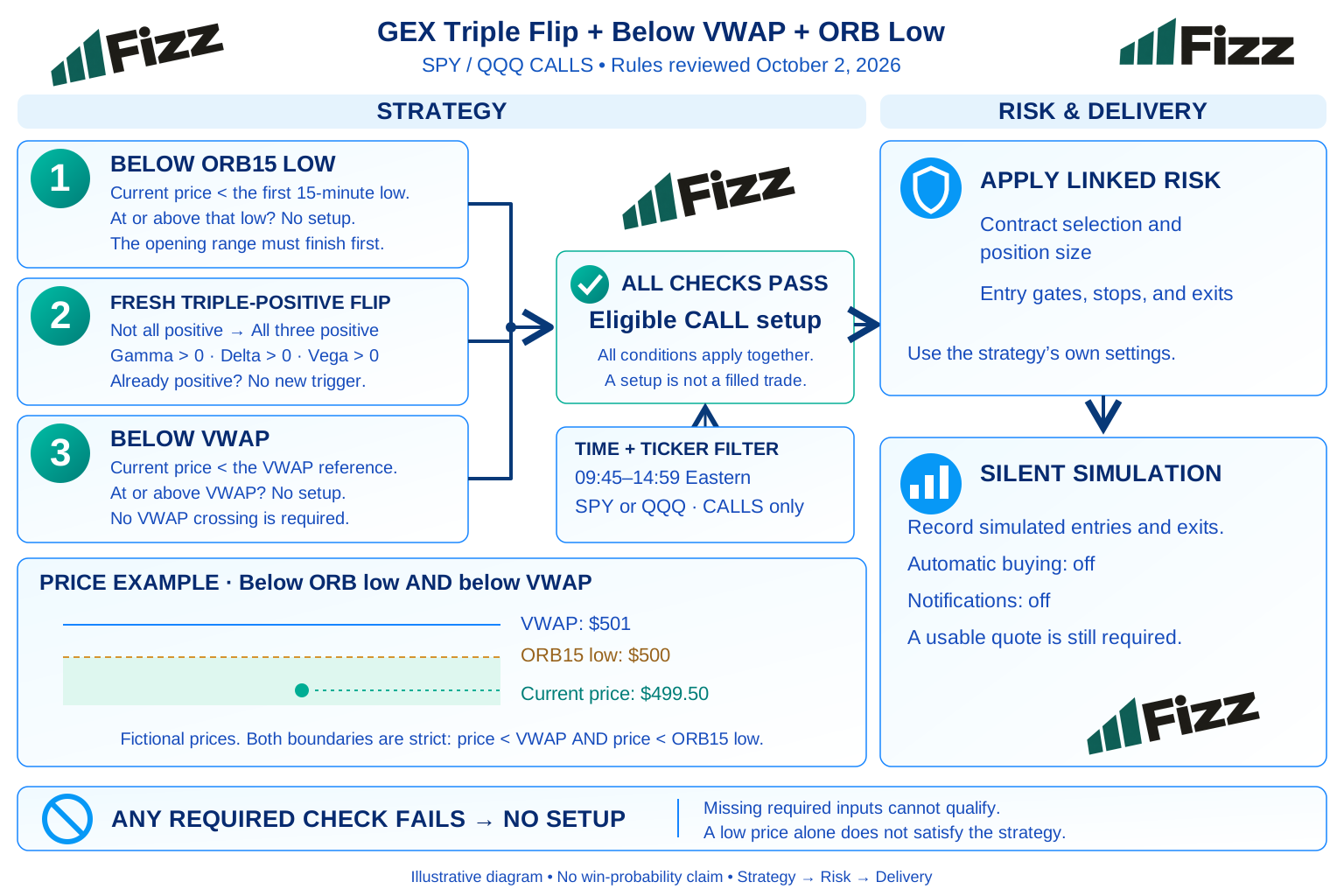
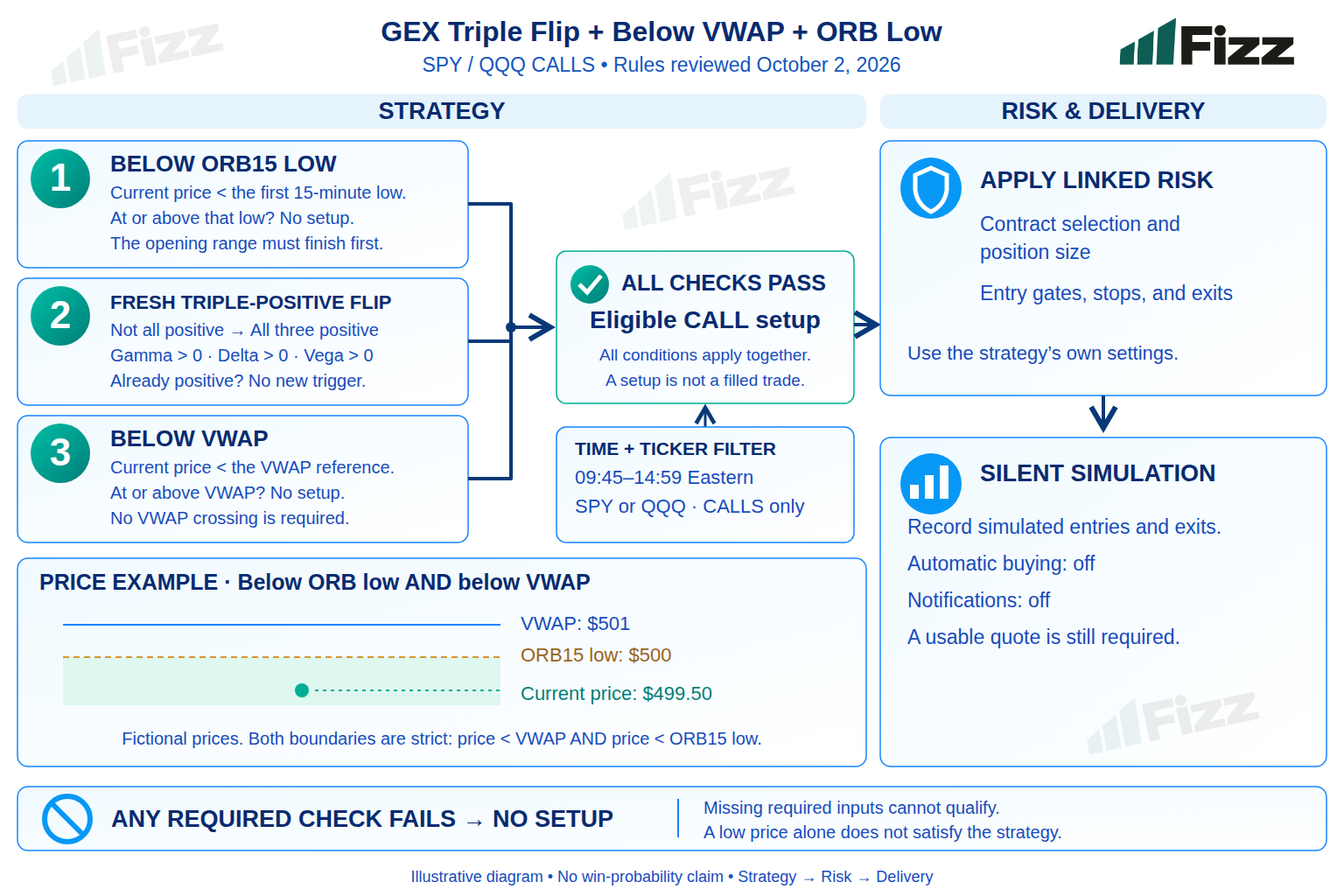
Price must be below VWAP and ORB15 low when gamma, delta, and vega change from not-all-positive to all-positive. Repeated positive readings do not qualify.
Price example: below VWAP and the opening-range low
01 · Recognize the setup
Below VWAP and below the opening range.
The setup begins below both levels
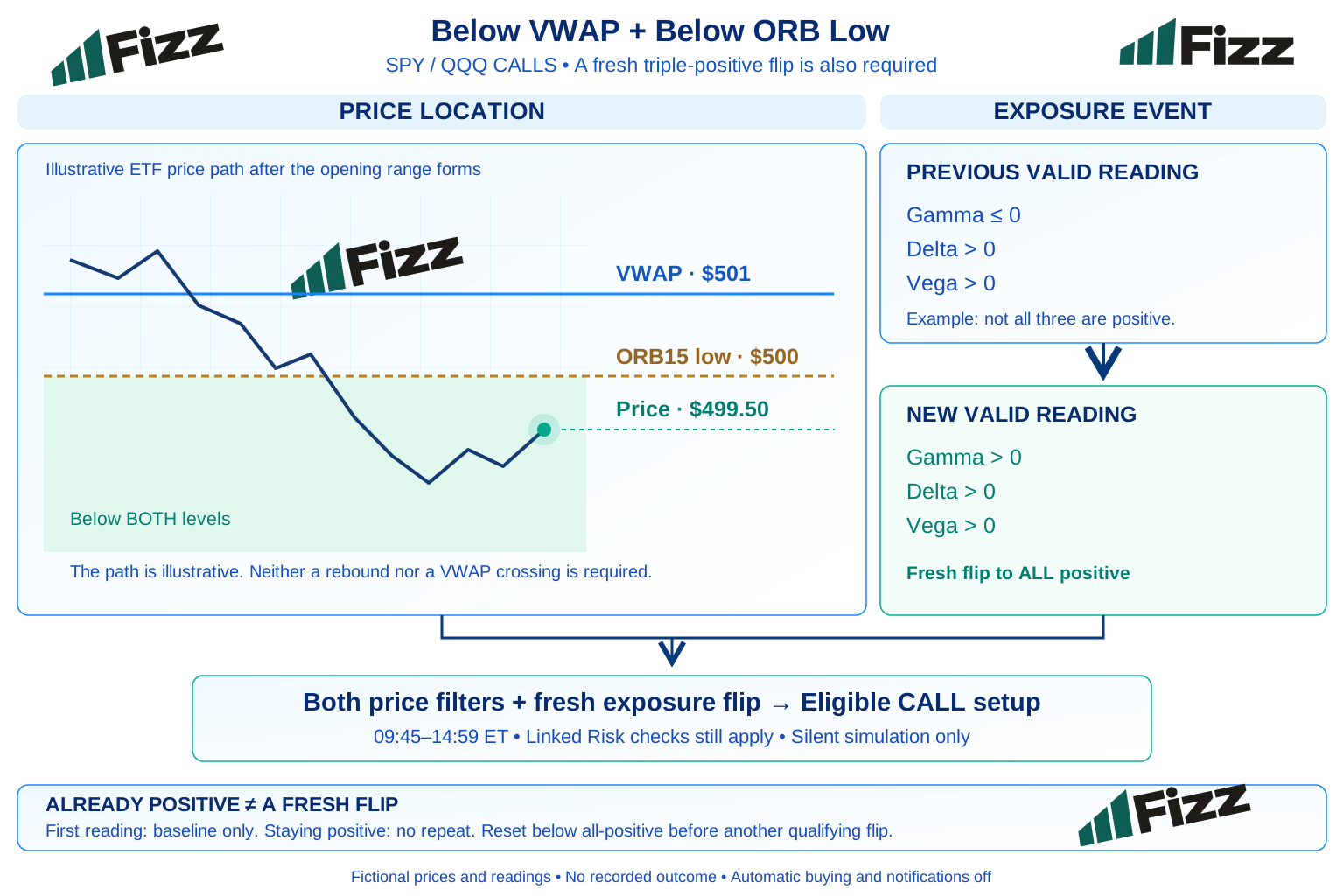
This SPY/QQQ CALL strategy requires current price strictly below the VWAP reference and strictly below the first 15-minute opening-range low. Price does not need to reclaim either level. The event is a fresh change in exposure: gamma, delta, and vega become positive together as a combined state. A low price alone cannot trigger the strategy.
Mark the first 15 minutes
The opening range uses the underlying ETF’s first 15 regular-session minutes, from 9:30 to 9:45 a.m. Eastern. Entries run from 9:45 a.m. through 2:59 p.m. Eastern. SPY and QQQ each use their own price, VWAP, opening range, and exposure state. Equality with either price boundary fails.
Require a fresh triple-positive flip
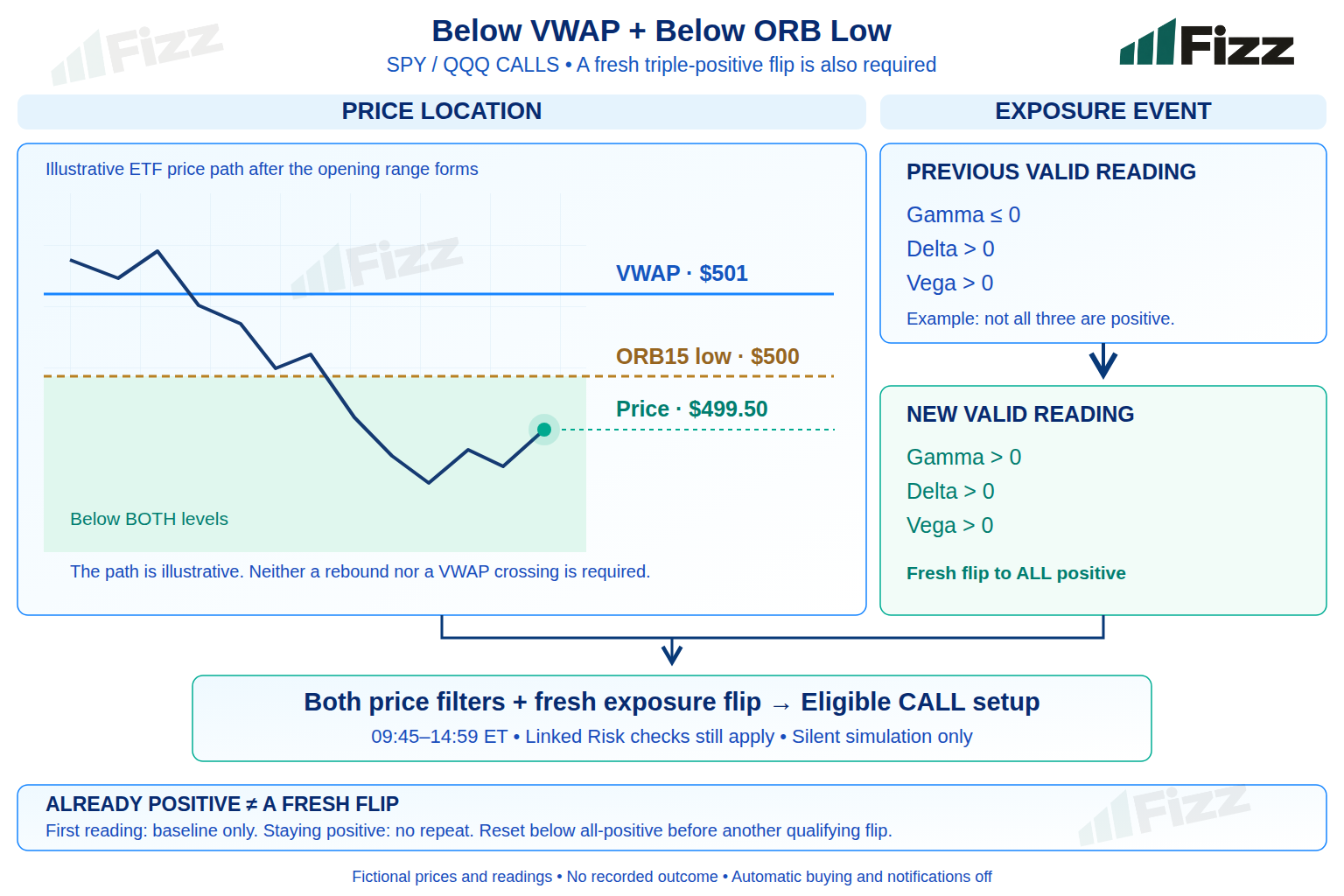
The previous valid exposure reading must not have all three values positive. The new reading must have gamma > 0, delta > 0, and vega > 0. One or two values can already be positive before the change. All three do not need to cross zero individually on the same update. A zero value is not positive. This replacement has no pulse threshold.
Staying positive is not another trigger
The first valid exposure reading establishes a baseline and cannot trigger. Repeated positive readings cannot trigger again. At least one reading must return to zero or below before a later all-positive reading can produce another flip. Another qualifying flip can trigger later that day. If price fails either filter when a flip occurs, a later price move does not reuse that old flip.
The price rule
Current price < VWAP AND current price < ORB15 low
Strict boundaries: touching either line does not qualify. Price must be below the lower of the two reference levels.
02 · Check the numbers
One fictional setup, three possible readings
Follow one fictional flip
Assume ORB15 low is $500, VWAP is $501, and current ETF price is $499.50. At the previous valid update, gamma is negative while delta and vega are positive. Gamma then turns positive; delta and vega remain positive. If price is still below both levels during the allowed entry window, this fresh combined-state flip qualifies. These values illustrate the logic, not a recorded trade.
$499.50
Price qualifies
Below $501 VWAP and the $500 ORB low. A fresh exposure flip and the time window must also pass.
$500.00
Price fails
At the ORB low. Equality fails the strict below-low condition.
No fresh flip
Setup fails
Price is below both levels, but exposure was already triple-positive. Another positive reading is insufficient.
Compare the near misses
If price is $500, equality with ORB15 low rejects the setup. If all three exposure readings were already positive, another positive reading is not a fresh flip. If a flip occurs while price is above VWAP, falling below VWAP later cannot rescue that event. The strategy waits for another not-all-positive reading followed by an all-positive reading.
03 · Separate setup from execution
A qualifying setup starts a simulation
Keep the simulation separate
This replacement has its own strategy identity and result version. It replaces only the SPY/QQQ above-VWAP profile added on October 2; the earlier QQQ strategies and recorded results remain separate. Automatic buying and notifications are off. A qualifying flip still passes through linked Risk checks and requires a usable option quote before a simulated fill can occur.
Understand the reviewed exits
The linked Risk rules include a −25% option loss stop eligible after eight minutes, profit protection starting at +25% with 15-percentage-point steps, and an exit after 20 minutes when losing. The simulation session ends at 3:00 p.m. Eastern. These are option-return rules, not ETF price targets. Modeled exit thresholds do not guarantee fills or cap a loss at the threshold.
Missing data cannot create a flip
The observer compares fresh engine exposure readings from the same session, expiration, and observed strike coverage. A new session, changed coverage, missing input, or stale source requires a new baseline. Duplicate or older readings cannot create another event. Stored observation state prevents a restart from repeating a consumed flip. A blocked entry does not reserve that flip for a later trade.
04 · Understand the evidence
A new study needs its own results
What the earlier numbers measured
The earlier table showing four trades, a 75% win rate, and +9.87% average return described the QQQ-only above-VWAP and below-ORB-low strategy. It did not test below VWAP or fresh triple-positive flips. One of those four closes was administrative, and the exit version changed between the two sessions. Those results cannot validate this replacement.
A new trigger needs new evidence
Do not transfer the older strategy’s win rate to this setup. Record the exposure state before and after each event, both price levels, the event time, and whether a simulated fill followed. Keep SPY and QQQ results separate. Label missing inputs, rejected flips, open positions, and administrative closures rather than assigning them hypothetical profits.
What the study should answer
Measure outcomes only for fresh flips that occur below both levels. Count independent sessions alongside filled simulations. Compare average option return, loss size, costs, and input coverage, using one fixed rule version. The question is whether the event adds useful information beyond price being low; the diagram explains the hypothesis rather than proving it.
Lesson details
Owner: Fizz product team · Article reviewed: October 2, 2026